Greenpeace, Why Must You Hate the Planet

 NO  Comments Off on Greenpeace, Why Must You Hate the Planet
Feb 102013
 

Duke Energy’s dinosaur ways

Duke Energy recently made two decisions that provided a tiny glimmer of hope to North Carolinians who have been dismayed by our utility’s reliance on polluting energy sources. … Perhaps Duke was beginning to recognize that antique energy sources like coal and nuclear power are not viable in the 21st century when more modern options exist. Unfortunately, Duke’s 20-year energy plan for the Carolinas, the subject of a Utilities Commission hearing in Raleigh on Monday night, extinguishes the hope that Duke’s good news could start a trend. … Duke’s plan forecasts that in 2032, 72 percent of its energy will come from coal, nuclear and gas-fired power plants. Only 2.25 percent will come from wind and solar power.

From Greenpeace’s QUIT COAL (and apparently Nuclear) campaign. The article parrots tidbits about Germany’s great wind and solar generation, but conveniently leaves out the pretty major problems they’re suffering because of it (wind is great, but you need SOME non-variable generation to stablilize the grid).

I really hate how this, as usual, lumps nuclear in with coal and natural gas. The weasel word clean is used to imply that sources of energy other than wind and solar are killing the planet, whitewashing the environmental impact of e.g. solar panel construction (there’s no free lunch). And… dinosaur? Is that implying that Uranium is a fossil fuel? I guess if you count the last generation of stars as dinosaurs. Is it implying that Uranium is a limited fuel? I guess if “we can extract enough to power civilization until the current relationship between the earth and sun ends” counts as limited (hopefully there’s some on any other planets we might colonize, but I’m not gonna be around in two billion years to find out!).

The problem is that we are in the global warming endgame. The previous three generations knew this would happen and lived their lives sucking down fossil fuels without concern for us in this day. So we have to stop using carbon generating energy sources now. And we have the technology: Nuclear Power.

Germany was a shining example of a country that drastically reduced emissions. And then they shut down their nuclear power… returning to relying heavily on fossil fuels.

And cannot operate their grid AT ALL without massive amounts of imported power from France… nuclear power from France. And… the entire thing is a sham, it turns out having massive peak load with no use, no ability to store it (because physics says we can’t build batteries large enough), and limited baseload generation is destabilizing the entire European power grid. I’m sure the folks suffering through rolling black outs in Bavaria are glad they have renewable power sources that don’t provide heat for them in the winter.

So… Germany and Japan shutting off nuclear means both of them have already announced they will not be meeting their carbon emission reduction promises. The last vestiges of the Kyoto protocol have gone up in … smoke (couldn’t help myself, forgive me).

A lot of this anti-nuclear “green” power stuff is just playing right into the hands of the fossil fuel industry! They are taking advantage of the fear of complex systems; hatred of nuclear power invokes similar reasoning as hatred of technological society as a whole.

Instead of abundant filthy, atmosphere destroying coal we’re just shifting to scarce … filthyatmosphere destroying … natural gas.

Wind… wind and solar have problems with land use. You can build gigawatts of nuclear in a mere square mile of land! Perhaps a couple hundred megawatts of solar in the same… land is a scarce resource, see e.g. the recent problems with Brazil displacing a tribe for clean hydro power. People like to sweep problems like that under the rug.

Shearon-Harris is the only reason the triangle enjoys below-average energy prices. Whereas all other sources of power have become more expensive to operate, nuclear has become cheaper: Shearon-Harris was uprated twice, has been online more than 95% of the time for the last decade (the 5% offline for fueling outages), and the cost of Uranium hasn’t changed much (fuel, however, contributes almost nil to the operating costs of the plant).

The rate hikes we face are ultimately caused by the rabid, unfounded opposition to nuclear in the 80s and 90s. If Shearon-Harris hadn’t been stonewalled (leading to construction of units 2-4 being halted, a huge increase in capital costs for Unit 1, and the lost resources that went into planning and beginning construction of the other units…) we would have four 960MW reactors i.e. all of central North Carolina would have been powered by carbon free fuel for over 20 years now. Let that sink in: and then think about how the same farce repeated itself all over the country.

If NC WARN hadn’t stonewalled the attempt to expand Shearon-Harris, we’d be building those first new AP1000 instead of Georgia, and would enjoy carbon free power in three years instead of ten years (not to mention the thousands of jobs building it, and then hundreds operating it). Instead, good intentioned environmentalists have undone their own work!

Really, scorning reliable baseload power is foolish. We need a mixture of solar, hydro, wind, nuclear, geothermal, etc. Scorning an energy source out of trumped up fears with no basis in science or engineering reality is foolish, and anti-environment. Which is why I cannot take Greenpeace seriously–they work AGAINST saving the biosphere!

And, alas, it seems they are quite effective at it.

Perils of the Cute Cat

 NO  Comments Off on Perils of the Cute Cat
Feb 092013
 

The intake filters on my computer clog with cat hair every other week. I’ve only had it for three months and have to wash the filters… but hey! Positive pressure and filters mean the inside is clean and:

image

image

image

image

image

image

image

And the Trellis Is Built

 NO  Comments Off on And the Trellis Is Built
Feb 072013
 

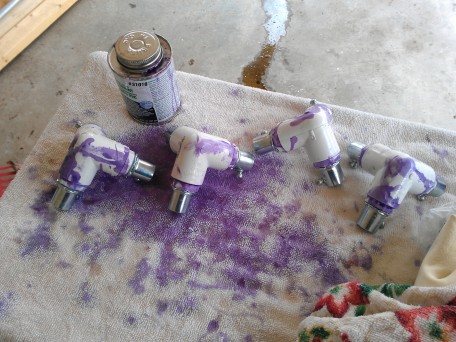
I didn’t die from the PVC cement fumes, and after that everything came together quickly (with assistance from bpt).

Garden Trellis Update: I Hate Building Things

 NO  Comments Off on Garden Trellis Update: I Hate Building Things
Feb 052013
 

So, it turns out the Internet’s sage advice that a 1/2″ EMT tube would fit into a 3/4″ OD PVC coupling is a lie. In fact, a 1/2″ PVC coupling is still too large >:O.

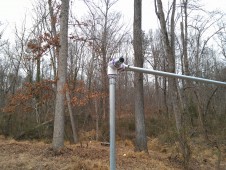
But! After a harrowing 90 minutes at the hardware store I discovered… a 1/2″ threaded pvc to 3/4″ slip adapter is compatible enough with threaded 1/2″ EMT so… the pvc adapter connects to the elbow, a set screw to threaded EMT adapter connects to the pvc adapter, and the conduit attaches to the EMT adapter.

At least the pair of adapters costs less than a single 3/4″ cotter pin, and it certainly is easier to deal with (build the elbows before hand, just tighten a screw to attach when I’m reaching for pieces above my head).

I guess I need to get some pvc cement… which costs as much as all of the EMT I’m using, so maybe I can find an alternative glue that will work acceptably for structural rigidity but not for pressurized water.

So now! After doing that whole “generating funds to continue paying rent” work thing tomorrow, more trellis construction. And pictures, finally.

The Garden, 2013

 NO  Comments Off on The Garden, 2013
Feb 052013
 

Last year I tried to upgrade my garden, but bit off way too much, ending with very little yield (only my containers, and then with only a couple of pepper plants since all of the seedlings died and I ran out of funds to get seedlings at that point).

So this year, something simpler. I’m going to try and germinate a few things (Aurora peppers, basil since I’ve had universal success, and kebab onions) and just live with getting transplants… and then some direct sown stuff (melons! squash! green onions! radishes! herbs!). This way, at worst I end up without a weird heirloom pepper I can survive without.

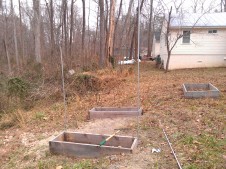
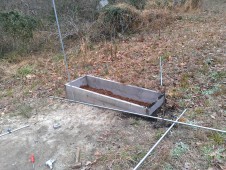
I also have the stuff I built last year: a pair of 5’x18″ beds dug into the ground (intended for use with a trellis), a 5’x3 raised bed ready to go, and the 18″ ends cut for another pair of 5′ or 6′ beds. And I happen to have 3 cubic feat each of peat moss, vermiculite, and perlite… a good chunk of hard work and expensive materials already exist, phew.

So! The first steps. I discovered that the city will sell me compost and mulch for dirt cheap, making this project affordable. $30 nets me a nice 65 cubic feet of compost, i.e. about three times as much as I need initially for all of the beds and my bins! Then, it looks like I can get enough topsoil for about $15. I’m probably going to nap a truckload of mulch too, since I need just enough that it costs as much to get it in smaller quantities, and there are a number of trees in the yard that could really use a good restorative mulching after years of neglect (exposed roots! weeds! erosion!).

The plan now is to make a base mixture of 1:1:1 peat moss:vermiculite:perlite (peat moss replaced with coir if I need a second bag… CAPTAIN PLANET), amended slightly with some light fertilizer. Then, for my containers, mix that 1:1 with compost. For the raised beds, I think I’ll start by mixing the compost/base mix 2:1 with the topsoil (the beds will have better drainage than the pots so I want to make the mix a bit heavier).

So… with the cheapness of city compost and already having plenty of base mix, onward! I think I’ll have the small beds filled within two weeks and plant some bunching onions and radishes, bpt planting some swiss chard and lettuce (yeah yeah, stereotypical early season crops WHO WANTS SOME SWISS CHARD). Those beds in June, however, get to start their real task: melons and squash!

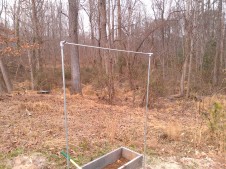
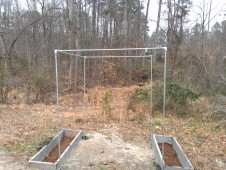
So, a trellis is needed. I devised a garden cube based on the designs in Square Foot Gardening; instead of a free standing trellis per bed, I envisioned have four beds (= 12-15 trellised plants) and a cube of EMT conduit in the middle. And so it shall be, but with only two (perhaps three, but I have until June to care and it sure takes a lot longer to level ground that you think it would) beds. Supplies:

  • 4 1/2″x4ft rebar
  • 6-8 1/2″x10ft EMT conduit
  • 4 3/4″ OD “Side outlet elbow junction” PVC connectors (these were an incredible pain in the ass to find)

The idea is simple enough: hammer the rebar into the ground, fit the EMT over, use my convenient pipe cutter to get them all to the same height, attach the pvc joints using magic, and then cut/mount the EMT for the top bars.

The problem is the pvc coupling. In my vision, I imagined that there was a vertical Tee + 90″ corner elbow EMT connector using those convenient screws to keep it in place. As luck would have it, and for now obvious reasons, that doesn’t exist. But! The Internet to the rescue! You can use pvc plumbing fittings, but keeping it together becomes a bit more complicated…

I saw suggestions to drill through the connection and use a cotter pin… I have a feeling that’s what I’m going to do in the end, but that’s… a pain. I have a drill around, but applying the force needed to go through the EMT when it’s all wobbly seems like it’d be challenging, or result in a drill going through some part of my body as things slip.

So, I’ll be attempting an easier method, probably doomed to failure…

  1. Drill a hole in each of the joints on the pvc elbow before construction
  2. Use a short screw to dig into the EMT in a similar fashion to the usual screw/friction connectors

If it works, hooray. I won’t be grumpy if it keeps the structure rigid enough for me to drill the cotter pin holes.

In any case, that damned trellis is getting built.

Bonus feature: I was thinking about getting a small green house or constructing a cold frame to germinate the peppers in (it would require hundreds of dollars of lighting crap to successfully start them, I think… sunlight is better than anything I can provide, except for that pesky freezing temperatures thing). Today, it dawned upon me that I already have a greenhouse… since I don’t need the trellis until June and it’s already a rigid cube… I just need a bunch of zip ties and plastic sheeting and I think I’ll have an effective environment for starting seedlings.

In theory, HOT PIX OF THE GARDEN CONSTRUCTION SCENE TOMORROW.